
Stone Guide · Ideas
10 Ways to Use Natural Stone in a Living Room
Ask most people where natural stone belongs in a living room and they will say the floor. That answer is not wrong, but it stops far too early. In the villas, apartments and hotel lounges we supply across Oman, the rooms that feel genuinely considered are the ones where stone appears in two or three places rather than one — a floor, yes, but also a fireplace surround, a slab of travertine behind the television, a marble tabletop that catches the afternoon light.
This guide sets out ten ways to bring real travertine, marble, granite and crystal into a living room, from full-height feature walls down to details most people never think to specify — with the practical trade-offs of each.
Before the ideas: think in layers, not surfaces
A living room reads as a whole. If you choose each stone element on its own, you end up with four materials competing for attention and none of them winning. The approach that works is to decide, early, which single element is the hero — usually the largest continuous surface — and then let everything else support it.
A useful rule of thumb: one dominant stone, one supporting stone, and at most one accent. A warm beige travertine floor with a honed marble fireplace and a single onyx detail is a scheme. Beige travertine floor, green marble wall, black granite table and a red-veined console is a showroom.
1. A full-height feature wall behind the seating
The wall behind the main sofa is the room’s natural focal point and the single most effective place to use stone. Full-height cladding — floor to ceiling, with the slab veining running continuously across the joints — turns a plain wall into the reason the room works.
Book-matched slabs, where two adjacent pieces mirror each other, give the strongest effect and are worth the extra material cost on a wall this visible. If the budget is tighter, a single band of stone at seating height, framed in plaster above and below, gets you most of the drama for a fraction of the slab area. Either way, the wall needs to be structurally sound and the fixing method planned before anything is ordered — our guide on how natural stone is installed on interior walls covers the mechanical fixing and adhesive methods in detail.
2. A stone fireplace surround
Even in a climate like Oman’s, fireplaces appear in mountain villas, majlis-style reception rooms and hotel lounges where they function as a design anchor as much as a heat source. Stone is the obvious material: it handles heat, it reads as permanent, and a surround uses a manageable quantity of slab.
Travertine suits a softer, more textural surround; marble suits a sculptural one; dark granite gives a sharp modern frame that recedes when the fire is not lit. We have covered proportions, hearth depth and material behaviour near heat in our dedicated guide to natural-stone fireplace design.
3. The television and media wall
The media wall is the fireplace of the modern living room, and it is one of the best uses of stone in the house — because the screen is dark, matte and rectangular, and stone is everything the screen is not. A slab surround gives the television something to sit within rather than float against.
Two practical points. First, keep the stone matte or honed directly around the screen; a high-polish surface will mirror the picture and every lamp in the room. Second, plan cable routing and ventilation before the slab is cut — chasing a channel into fitted stone afterwards is expensive and rarely invisible.
4. Stone-topped coffee and side tables
A stone tabletop is the lowest-commitment way to introduce a new material into a finished room. It costs a single offcut, it needs no building work, and it can be replaced in an afternoon if tastes change.
For coffee tables, 20 mm is usually enough on a supportive frame; 30 mm reads more substantial and is worth it if the top is large or the base is open. Ask for a softened or bullnose edge on anything at shin height. If the table will hold glasses and coffee daily, granite or a denser marble will forgive more than a soft, open travertine will.
5. Console, credenza and shelf tops
Behind the sofa, along a corridor wall, or above a low storage run, a slim stone top ties joinery into the rest of the scheme. This is where offcuts from a larger order genuinely earn their keep: a console top rarely needs more than a metre and a half of material, and using the same stone as the floor or fireplace creates continuity without adding another material to the room.
Floating stone shelves work on the same principle: keep them 30–40 mm thick, support them on concealed steel, and limit the span, because stone is strong in compression and far less forgiving in bending.
6. Window sills, reveals and deep ledges
Sills are the most overlooked stone detail in a house and one of the most useful. In Omani villas with deep window reveals, a stone sill turns an opening into a ledge people actually use — for plants, books, or simply to sit against. Stone also handles the daily temperature swing and direct sun at a window far better than painted timber or MDF.
Specify a drip groove on external-facing sills, choose a light tone to avoid heat build-up in direct sun, and match the sill stone to the floor rather than the wall — it makes the room feel resolved rather than assembled.
7. A backlit onyx or crystal panel
Translucent stone is the one idea on this list that changes the room after dark. Backlit with an even LED panel, a slab of onyx or crystal stone stops being a surface and becomes a light source, with the mineral banding glowing from within.
It works best in a defined, contained area: a bar front, a niche, a panel behind a console, a single wall in a majlis. It needs even, low-heat lighting behind it and a careful choice of slab, because thickness and banding decide how the light reads. Our crystal and onyx-look stone range is where most of these projects start.
8. Wet bars, coffee nooks and serving counters
Many living rooms in Oman include a serving counter or a coffee station, either built into the room or in an adjoining alcove. This is a working surface, so specification matters more than looks: it will see hot cups, citrus, coffee and the occasional spill.
Granite is the safest choice here — dense, hard, and largely indifferent to acid. Marble and travertine can absolutely be used, but they should be sealed properly and the client should understand that a patina will develop. If a counter is going to be photographed for the next decade and never wiped down promptly, choose the granite.
9. Columns, arches and thresholds
Wrapping a structural column or an arch in stone is a traditional move in Gulf interiors, and it still works when handled with restraint. The effect depends almost entirely on the joint layout: a column clad in four large faces with tight, aligned joints looks architectural; the same column in twelve small pieces looks tiled.
Thresholds are the quieter version of the same idea: a single stone strip where the living room meets a corridor or terrace closes the transition and protects the most-walked edge of the floor.
10. Floor borders, inlays and stone “rugs”
If the floor is already stone, a border or inlay defines zones in an open-plan room without a single wall. A darker frame around a seating area, or a contrasting panel where a rug would otherwise go, gives an open plan the structure it usually lacks.
Keep the geometry simple and set it out on the actual room dimensions, not the drawing — a border that dies awkwardly into a door reveal undoes the effect. If you are still choosing the base material, our comparison of the best stone for a living-room floor covers how marble, travertine and granite behave underfoot.
Combining stones without the room feeling busy
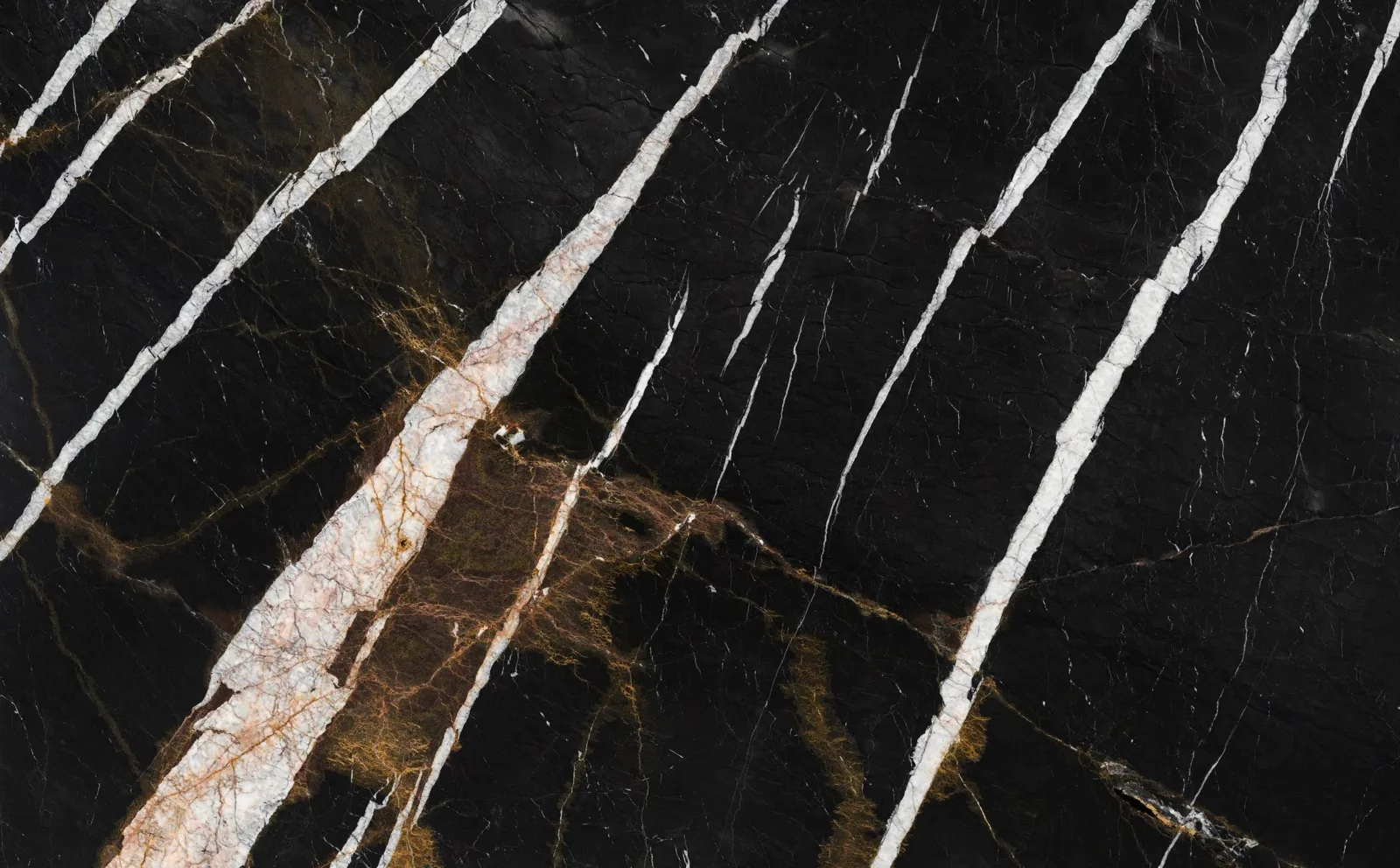
The most common mistake in stone-rich living rooms is not choosing the wrong stone; it is choosing too many. Three tests help. Do the stones share an undertone — are they all warm, or all cool? Is there a clear hierarchy of pattern, with one busy stone and the rest quiet? And does the finish vary enough to create interest without adding a fourth colour?
That last point is underrated. A polished and a honed version of the same stone read as two related materials rather than one repeated surface — the cheapest way to add depth while keeping the palette disciplined.
Practical notes for living rooms in Oman
Three things come up on almost every project here. Sunlight is intense, so a highly polished floor near full-height glazing will produce glare for most of the day — honed is usually the better call for large floor areas, with polish reserved for vertical surfaces and tabletops. Air conditioning means large temperature swings across a day, which makes movement joints and a competent fixing specification more important than the stone choice itself. And dust is constant, so a surface that shows every mark will be resented; a light, softly patterned travertine or a mid-tone marble hides everyday dust far better than a dark, high-gloss slab.
None of this rules anything out — it simply means the finish decision deserves as much attention as the stone itself.
Frequently asked questions
What is the best natural stone for a living room?
There is no single answer, because a living room has several different jobs. Travertine is the most forgiving all-rounder for floors and walls, marble is the strongest choice where you want a hero surface, and granite is best for anything that will be worked on, such as a bar or serving counter. Most well-resolved rooms use two of them rather than one.
Can I use natural stone on a living-room wall in an apartment?
Usually yes, but the wall build-up decides the method. A solid blockwork or concrete wall can take full slab cladding with mechanical fixings. A lightweight partition may need thinner material, a reinforced substrate, or a change of approach — this should be confirmed before slabs are ordered, not after.
Is stone cold underfoot in a living room?
Stone takes the temperature of the room around it. In an air-conditioned interior it will feel cool, which most people in Oman consider a benefit. A honed or textured finish and warm-toned material both make a floor feel less clinical than a dark, high-polish one.
How much stone is too much in one room?
As a working guide, one dominant surface plus one or two supporting elements. Once a room has stone on the floor, a full wall, the fireplace, the tables and the sills all in different materials, the eye has nowhere to rest. Repeating one stone in several places is almost always better than introducing a new one.
Does a stone feature wall need special maintenance?
Very little. Vertical surfaces get no traffic and see far less spillage than floors or counters, so a dust and an occasional wipe with a pH-neutral cleaner is usually enough. Sealing is worthwhile on porous stones such as travertine, particularly near a fireplace or a bar.
Planning stone for a living room?
Veltora supplies premium Iranian travertine, granite, marble and crystal to architects, designers, contractors and developers across Oman. Send us the room — floor area, wall heights, the elements you want in stone — and we will come back with suitable materials, finishes and an itemised estimate covering material, fabrication and delivery.